
The Go-To Digital Twin Infrastructure for Staging, Fixtures, and High-End E-Commerce
The Vision: Industrializing the Spatial Asset
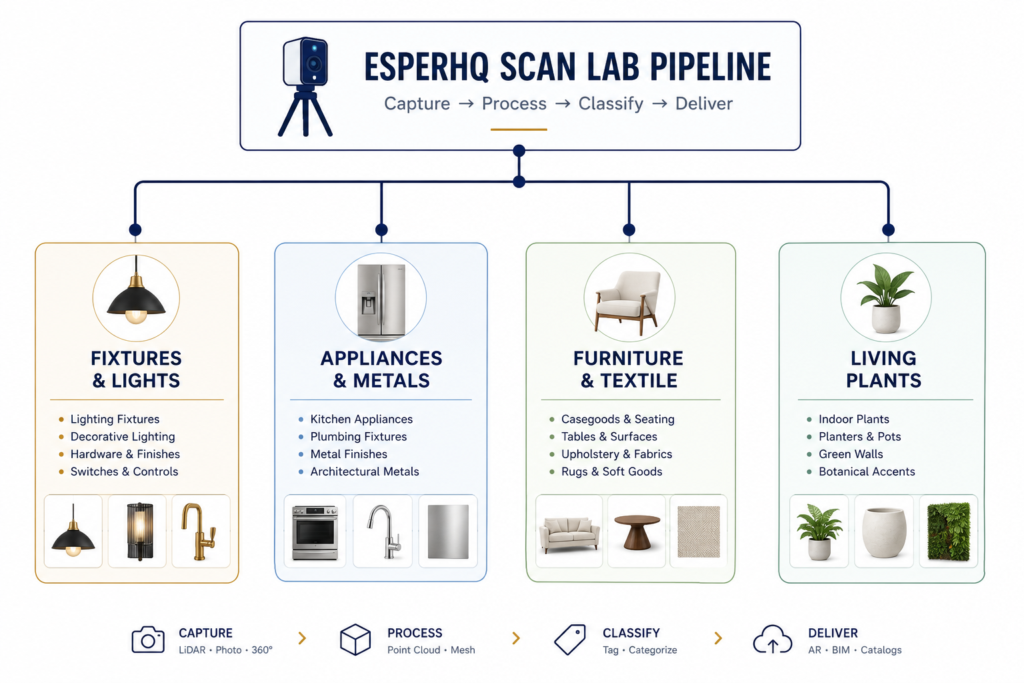
Traditional product photography and manual 3D modeling are slow, expensive bottlenecks for luxury e-commerce and high-end staging. The EsperHQ Scan Lab at Miami Circle completely upends this by establishing an industrialized, high-throughput pipeline for photorealistic digital twins.
By leveraging EsperHQ multi-camera arrays (TriggerBox/PowerBox hardware) and specialized geodesic light tracking, we eliminate the manual work of 3D asset generation. We capture instantaneous, pipeline-ready geometry and multi-directional lighting data (specular, diffuse, and normal maps) for fixtures, appliances, furnishings, and living plants.
Miami Circle is no longer just a design hub—it is the regional infrastructure engine supplying the spatial web, AR commerce, and digital staging industries.
Targeted Asset Verticals
1. Luxury Fixtures & Lighting
- The Challenge: Capturing the true reflectivity of polished brass, chrome, glass, and active illumination sources without severe glare or digital artifacting.
- The Esper Solution: Multi-angle cross-polarization and programmable flash sequencing isolate specular reflections. This yields flawless assets for architectural specification platforms and high-end bathroom/kitchen brands.
2. Premium Appliances
- The Challenge: Large-scale metallic surfaces, brushed stainless steel, tinted glass panels, and intricate interior cavities.
- The Esper Solution: Structured light combined with multi-camera photogrammetry captures crisp, millimetric geometry of complex shapes, including sub-assemblies (e.g., opening a luxury range oven door in AR).
3. Furnishings & Textiles
- The Challenge: Accurately representing velvet, leather, complex weaves, and organic wood grains for online furniture sales.
- The Esper Solution: Multi-directional photometric stereo capturing microscopic surface detail. This translates fabric textures into true 3D material maps, allowing digital staging designers to drop a sofa into a room twin with perfect shadow and light interplay.
4. Living Plants & Biophilic Elements
- The Challenge: Staging requires lush, hyper-realistic plants, but organic structures are notoriously difficult to model by hand due to complex, overlapping leaf geometry.
- The Esper Solution: Instantaneous, sub-millisecond multi-camera triggering captures organic movement-free frames. This generates optimized, hyper-detailed plant twins for luxury architectural renderings and virtual walkthroughs.
Operational Workflow: From Physical Intake to Digital Twin
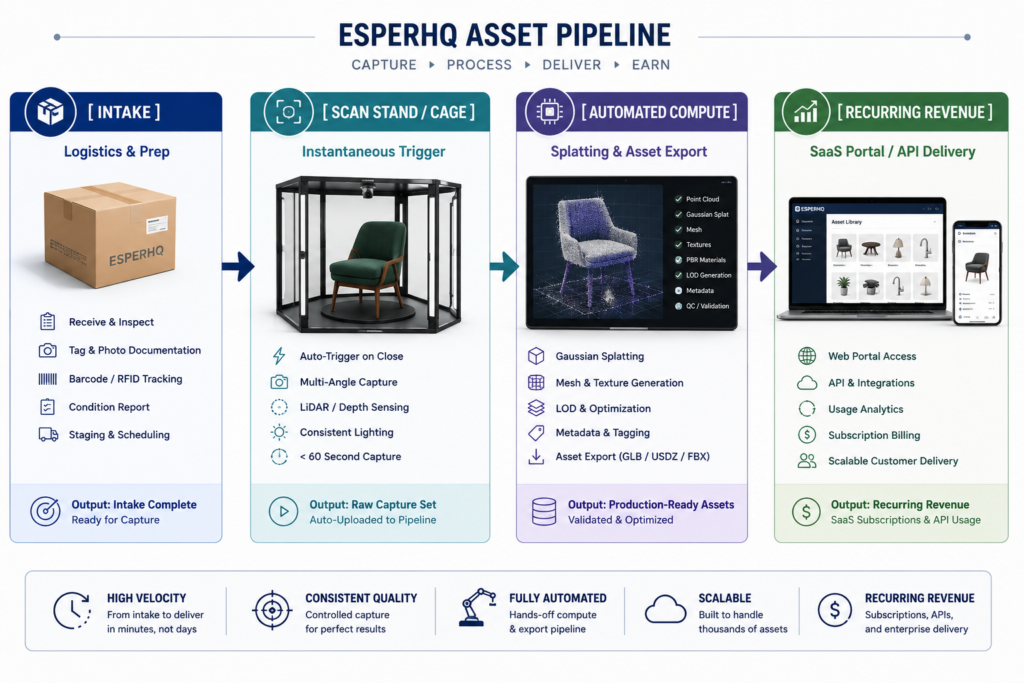
Step 1: Intake, Tagging & Preparation
- Logistics: Local showrooms, staging companies, and furniture manufacturers drop off physical inventory at the Miami Circle loading bay.
- Prep: Items are tagged via asset IDs, cleaned, and mounted to the center of the Esper array or onto an automated precision turntable synced with the camera cluster.
Step 2: Instantaneous Multi-Angle Capture
- The Array: A modular Esper ScanStand system outfitted with tightly synchronized DSLR/machine vision cameras and specialized LED LightBars.
- The Action: The system executes a zero-motion, multi-exposure lighting sequence in milliseconds, completely bypassing the hours required by traditional single-camera setups.
Step 3: Automated Computation Engine
- Processing: Raw images route directly to a local high-performance processing workstation.
- Outputs: The pipeline uses neural radiance fields (NeRF), Gaussian splatting, and inverse rendering to instantly output lightweight, web-optimized formats (
.glb,.usdz) alongside high-fidelity developer assets.
Step 4: Asset Delivery & Cloud Infrastructure
- Distribution: Clients access their files via a dedicated asset management portal.
- Integration: Files are instantly ready to be pushed to online furniture marketplaces, spatial computing apps, virtual staging software, or architectural simulation platforms.
Commercial Architecture & Monetization Model
Whitelabel Scanning Retainers (B2B)
- Target: High-end furniture brands, appliance distributors, and luxury home staging firms.
- Model: Monthly subscription tiers covering a fixed number of inventory assets scanned per month.
- Value Proposition: Turns physical inventory updates into immediate digital assets for online storefronts and virtual staging catalogs.
The “Twin-to-Sell” E-Commerce Pack
- Target: Online boutique furniture retailers and antique dealers.
- Model: Flat per-item scanning fee including web hosting of the interactive 3D/AR model.
- Value Proposition: Dramatically lowers shopping cart abandonment by letting buyers preview high-ticket items in their own space using precise mobile AR.
Digital Staging Ecosystem Licensing
- Target: Interior designers, real estate developers, and virtual staging platforms.
- Model: A subscription-based spatial library of digital twins captured directly from Miami Circle inventory.
- Value Proposition: Designers can build virtual rooms using real, purchase-ready local inventory rather than generic, unbranded 3D models.
Strategic Market Positioning
By pairing the spatial prestige of Miami Circle with an enterprise-grade EsperHQ capture pipeline, this facility shifts the digital twin market from a slow, bespoke artistic process to a scalable, predictable utility. We are the localized infrastructure that turns physical design pieces into highly profitable, liquid spatial assets.

Author: EverSafe Systems Alliance
EverSafe Homes is a Southeast-based resilient construction and specification platform focused on high-performance building systems, architectural innovation, immersive environments, and alliance-driven development. Headquartered in Atlanta’s Miami Circle design district, EverSafe connects builders, architects, manufacturers, and developers through education, media, demonstration spaces, and future-focused construction initiatives.