
When evaluating building systems, the question isn’t just about the cost of a single block—it’s about the value of the entire envelope.
The reality is that monolith/polyurethane systems are usually more expensive upfront than standard EPS (Expanded Polystyrene) ICF systems like Rhino Block. However, the true economic argument is that they can become significantly more cost-effective at the whole-building level.
The distinction lies in the details: labor, wall thickness, HVAC downsizing, and long-term durability.
Simplified Market Positioning
Understanding where each system thrives is the first step in choosing the right path for your project.
Typical EPS ICF (Rhino, Nudura, Fox, Logix, etc.)
These systems are the industry stalwarts. They are best positioned for:
- Lowest entry cost: Ideal for budget-conscious projects.
- Broad installer familiarity: Most ICF contractors are trained specifically on EPS.
- Standard residential construction: Perfect for single-family homes using traditional methods.
- Existing labor pools: Easier to find crews who have “stacked block” before.
Monolith / Polyurethane ICF
Polyurethane is a premium material designed for high-stakes environments. It is best positioned for:
- Premium-performance construction: High-efficiency builds and Net Zero targets.
- Thinner, high-R walls: Maximizing insulation without losing floor space.
- Multi-story projects: Where structural rigidity and weight-to-strength ratios matter.
- Resilient housing: Areas prone to extreme weather or high moisture.
- Pre-panelization: Projects that prioritize speed and factory-controlled quality.
Material Cost Reality
The price gap is real, but it’s often bridged by performance.
Typical EPS ICF
Industry sources estimate a range of $7–$11 per square foot for the wall material system (installed with concrete and rebar), depending on the specific market and design complexity.
Polyurethane Systems
Polyurethane foam is inherently more expensive to produce than EPS. Systems like Monolith, polyurethane-based blocks, argue that they offset this premium through:
- Higher R-value per inch: Better thermal resistance in a smaller profile.
- Thinner walls: More usable interior square footage (crucial in urban builds).
- Lower HVAC requirements: Downsized equipment costs due to a tighter envelope.
- Durability: Less damage during shipping and handling, leading to less job site waste.
Where the Narrative Shifts: System vs. System
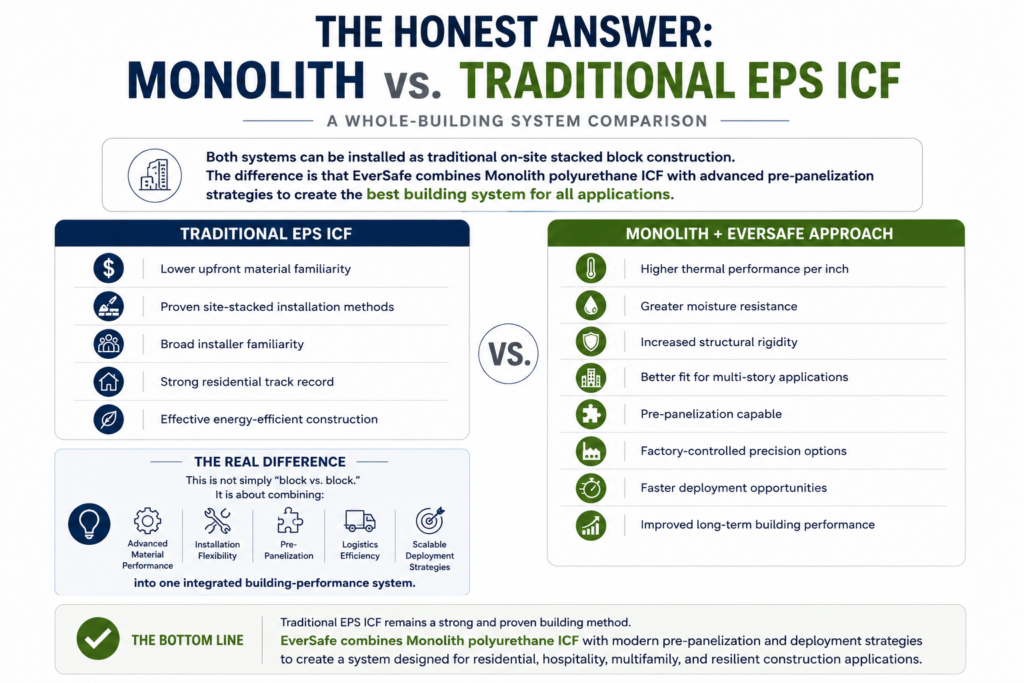
The real comparison is NOT “block vs. block.” It is “entire building system vs. entire building system.”
When you look at the EPS wall, you may face thicker foam assemblies, larger HVAC sizing, more intensive bracing requirements, and higher shipping volumes. In contrast, a Monolith wall offers:
- Increased Floorplate Efficiency: Thinner walls mean more sellable/rentable square footage in hotels and multifamily units.
- Moisture Performance: Polyurethane’s density makes it naturally more resistant to moisture absorption.
- Structural Rigidity: Denser foam provides a stronger form during the concrete pour.
Why EPS Still Wins (For Now)
We have to be honest: EPS systems still dominate the market. They benefit from a mature supply chain, trained crews in nearly every zip code, and proven code paths. Even a technically superior system can lose to “labor availability” and “contractor comfort.”
The Strategic Opening: The Quantum Pairing
This is why the Quantum pairing is a game-changer. While traditional EPS is still largely site-stacked and labor-dependent, the Monolith model shifts toward:
- Pre-panelized components
- Factory-controlled precision
- Logistics-oriented deployment
By moving the labor from the field to a controlled environment, the “premium” cost of the material is mitigated by the radical efficiency of the installation.
The Strongest Framing
We don’t claim that Monolith is always cheaper. That would be a disservice to construction professionals.
The stronger, more credible statement is this:
“Typical EPS ICF systems usually win on upfront material familiarity and initial cost. Monolith’s polyurethane system competes by delivering higher thermal performance per inch, improved moisture resistance, and increased rigidity—especially when paired with pre-panelization and multi-story deployment strategies.”
The Bottom Line
EPS ICF is a construction product.
Monolith + Quantum + EverSafe is an integrated building-performance platform.
That is the real differentiation. We aren’t just selling a better block; we are deploying a faster, thinner, and more resilient way to build.

Author: EverSafe Systems Alliance
EverSafe Homes is a Southeast-based resilient construction and specification platform focused on high-performance building systems, architectural innovation, immersive environments, and alliance-driven development. Headquartered in Atlanta’s Miami Circle design district, EverSafe connects builders, architects, manufacturers, and developers through education, media, demonstration spaces, and future-focused construction initiatives.